It's now Tues day, 9 November (Independence Day in Camodia), and we're currently chilling out on a wonderful, relatively unspoilt beach in Sihnoukville for a couple of days. We spent 5 days back in Phnom Penh from Wed, 3 November, after completed the 4-week Intrepid Travel tour. The tour was absolutely fascinating and perfectly organised, with a great tour leader and several excellent local guides. As we neared Bangkok for the end of the trip, we both decided that we wanted to explore a little more of Cambodia, hence a few days here and there. After a boat trip to Bamboo Island tomorrow, we're planning to move on, via Kampot for a couple of days, to a place called Takeo, where we've arranged to work in an orphanage for a week or so. After that, back up to Laos, where we'll hopefully meet up again with Jo, and do some more volunteering.
Our pace of life has slowed down now that we're no longer on the tour. That may mean that there is less to write about each time we post a blog (which might help Mike not to miss his Friday night beer at The Bells - heaven forbid!). Meanwhile, however, as we've mentioned quite a lot about Phnom Penh before, we just wanted to share some random impressions about Cambodia:
1. The Cambodian people, particularly the ethnic Khmers, are really quite different from the people we've seen in the other three countries so far. Many are darker-skinned, and seem to have some of the characteristics of Africans - broad noses/nostrils, thick lips, and very slightly bulbous eyes. They also remind us of Uzbek people in their build, particularly the men - very powerfully built indeed.
2. Around the streets in Phnom Penh, we kept hearing what sounded to be a child's squeaky toy being used repetitively. We've now discovered that these are the Khmer equivalent of a rag-and-bone-man's bell - men and women, pulling or pushing hand-carts around the streets, collecting recyclables from homes, hotels and restaurants.
3.All the food we've had so far, in all four countries, has been amazingly delicious, fresh and good. Thai seems to be the hottest (in spice terms), but all of the others have also been wonderful. We've had more fish and seafood, as well as rice and noodles, than you can shake a stick at, and they seem to use loads of fresh vegetables and herbs in just about every meal. The prices are really cheap too. A main meal here in Cambodia probably averages around £3-4, and a large mug of beer around £1.00-£1.50. Wines, though, tend to be pricey, and so we've avoided those for the most part. Cocktails, on the other hand, can be had for around £2.50-£4.00.
4. Before now, I've mainly been quoting prices here in Cambodia in US dollars. The official currency is the Riel (yes, riel=ly!); however, hardly any business is interested in using riels, all prices are quoted in dollars, and the only time we ever get any riel is in small change from time to time.
5. Since coming over to Indo-china, we've become millionaires! In Laos, for example, we took out 3 million in one go from an ATM - but please don't cancel our lottery tickets, Sandra, as 3,000,000 Kip is around £100!
6. One of our all-time favourite singer-songwriters, Leonard Cohen, was due to be holding a concert here in Phnom Penh in a few weeks' time. We had toyed with the idea of coming back from wherever we were to see it, as we love all things Leonard, but the tickets started at £200 each! Happily for us, we've read in the local press that the concert has been postponed, with the promoters denying that the ticket prices were to blame, and citing instead 'production difficulties'. It was due to have been a concert partly to raise funds for local charities in Cambodia, and the report says that Leonard has committed himself to making a 'substantial donation' , despite the postponement.
7. Another thing we've noticed here is that just about every street corner where there are pavement cafes and restaurants, is staffed almost full-time by a uniformed tourist police/security guard, whose job seems to be to look after any posh cars or motos that are parked in front of the restaurants, move beggars and street vendors on occasionally, and rearrange any tables and chairs which are vacated by customers. A strange job indeed - but maybe it's been instrumental in making Phnom Penh such a safe place for tourists. The atmosphere all around the streets in the evenings is just wonderfully relaxed and slightly festive. During the day-times, however, especially around the Foreign Correspondents' Club, we sometimes feel we've been parachuted into the middle of a Graham Green novel! Very 50s colonial indeed.
Next posting, we'll add some random photos, too!
Tuesday, 9 November 2010

Thursday, 4 November 2010
Angkor Wat?
Often known as the eighth wonder of the world - with good reason: it's known locally as the heart and soul of Cambodia - we visited this largest religious structure in the world, the Khmer people's national symbol, the epicentre of their civilisation, the source of fierce national pride.
But first we had to take a very comfortable, seven-hour, air-conditioned private bus journey from Phnom Penh to Siem Reap, through absolutely wonderful rural scenery, loads of really interesting small farmsteads, most with houses built on stilts over the lotus-flower strewn ponds which were their 'front gardens', and most with two or three cows or buffalo tethered somewhere near the road. We stopped on the way at a place called Skun village, also known as Tarantula village, because here this arachnoid, fried to a crisp, is a great delicacy (ugh!). In the market here, there were large bowls full of live tarantulas, from which the discerning customer could choose those they'd like to have cooked for them, rather like one might in an up-market fresh fish/lobster restaurant in the West. I have to say that, though some of our group were brave enough to get up close to these eight-legged creatures, I couldn't bring myself to get anywhere near. Andy did, though, and managed to get a photograph of Nak enjoying this particular treat - as you'll see below!
[Incidentally, in response to JJ's comment, no, I didn't actually have to eat the frog in Phnom Penh, but I did, having eaten frogs' legs several times in the past, and to eat the whole body in one seemed a bit of a challenge. It was really quite nice, but tasted mainly of salty cooking oil and garlic! Apart from the crunchy bits, of course. But the spider was different: I've never had spiders' legs before, and the whole spider would have taken several mouthfuls, so my usually healthy appetite took to its two legs and deserted!]
We arrived in Siem Reap, home of our guide Nak, and jumping-off point for the Angor Wat complex, at around 3 pm, and had an orientation walk with him around this mainly tourist-trap town before the sun set. In the evening, we went to a local restaurant in, would you believe it?, Pub Street (!) where, amongst many
fairly Western bars and eateries, there were loads of places offering a seat on the side of large fish-tanks in which you are invited to dangle your feet to allow the fish to eat the dead skin from them. We saw loads of people giggling with delight and slight revulsion, but didn't have time to try them ourselves - perhaps we will at some other point on this trip.
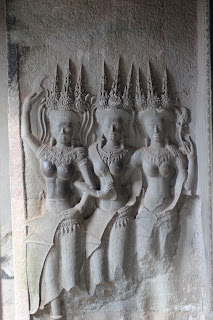
In the evening, we went to a Khmer restaurant in Pub Street, called The Temple, where we watched a beautiful performance by their Apsara dancers. It's difficult to describe this ancient form of dance: it's very balletic, though often with incredibly tiny, immensely graceful, movements of the dancers' feet and hands in particular. The word Apsara is most closely translated as 'nymph', and I was absolutely captivated by the whole show. I have to say, though, that it was clearly a minority interest in our group, and most of them went off elsewhere - mainly to the Halloween celebrations happening in the other very Western bars nearby - leaving Andy and me absolutely riveted to the Aspara dancers' performance. We'll put a photo at the end of the blog, but we do also have some brief video-clips to remind us of this beautiful performance. We also had a really nice traditional Khmer meal beforehand.
The next day, we went off to see two of the temples in the Angkor Wat complex - the Bayon and Banteay Srea. It's worth saying that the temples of Angor are spread out over no less than 40-miles, and it would take several weeks to cover them all. The temples were built between the 8th and the 13th centuries, and range from temples made of bricks to vast stone (sandstone or limestone) temple complexes. They are absolutely mind-blowing, but almost impossible to describe in words. So, we'll stick to some trivialities instead. The whole time we were at these two sites, we were continuously stalked by this woman, whom some of you will have heard of, called Hilary something. Clinton, I think. The problem with being so famous, of course, is that it's difficult for us to shake off these kinds of hangers-on, and so everywhere we went, she and her entourage of security guards turned up just minutes later. We eventually managed to shake her off, and went off with our tour-bus to a local village where we watched people boiling up sugar-cane to make into candy - very sweet indeed. Once again, the village children all came thronging around, and joined in joyfully while we chanted the English words counting from one to ten - rather more delightful than our experience around the temples of Angkor. At the entrances to these places, there are loads of really young children, aged from around 5 to 10 years old, all selling souvenirs in a pretty assertive (though not quite aggressive) way. As soon as a group of tourists turn up, these children swarm all around them, offering just about everything for a dollar or two. Intrepid Travel's policy is that travellers should not buy from these children, as they should really be in school, and it encourages them to be too materialistic and greedy. Nak, however, says that it's not quite that simple. Though primary schooling is supposed to be free, many teachers, whose government salaries are pathetic, demand some kind of payment from their pupils for tuition fees, which means that many families just cannot afford to send their children to school, especially given that large families are still the norm here, with most rural dwellers having 8, 9 or 10 children.
The children themselves, though, seem pretty clued-up in a number of ways. They usually ask "where you flom?", as part of their standard patter and, whenever we said we're from England, most of them could immediately recite something like "Oh, Ingerland - capital London, Plime Mihister David Cameron, use to be Gordoh Blown, but now change". One of our group, a Welshman who was a bit fed up with being harassed by these child-entrepreneurs, said glibly to one of them that he'd buy something if they could name the capital of Wales. Quick as a flash, the child said "Cardiff", and Rod was duty-bound to part with $10 for a load of tatty fridge-magnets, much to the enjoyment of the rest of us. A little later, having myself bought several bangles from one child who wouldn't stop asking me to buy more, I offered to sell him some back for $2 (I'd paid $1); again without hesitation, the 8-year-old said "Okay, I buy for $2, but you buy back for $3". It's a bit humbling being done-over so deftly by these kids!
That evening, Andy and I, together with Michel, a charming young Swiss man in our group, went off to the street market in Siem Reap for some real Khmer food, and found ourselves being served by an equally charming 'lady-boy' - the first we'd seen outside of Thailand
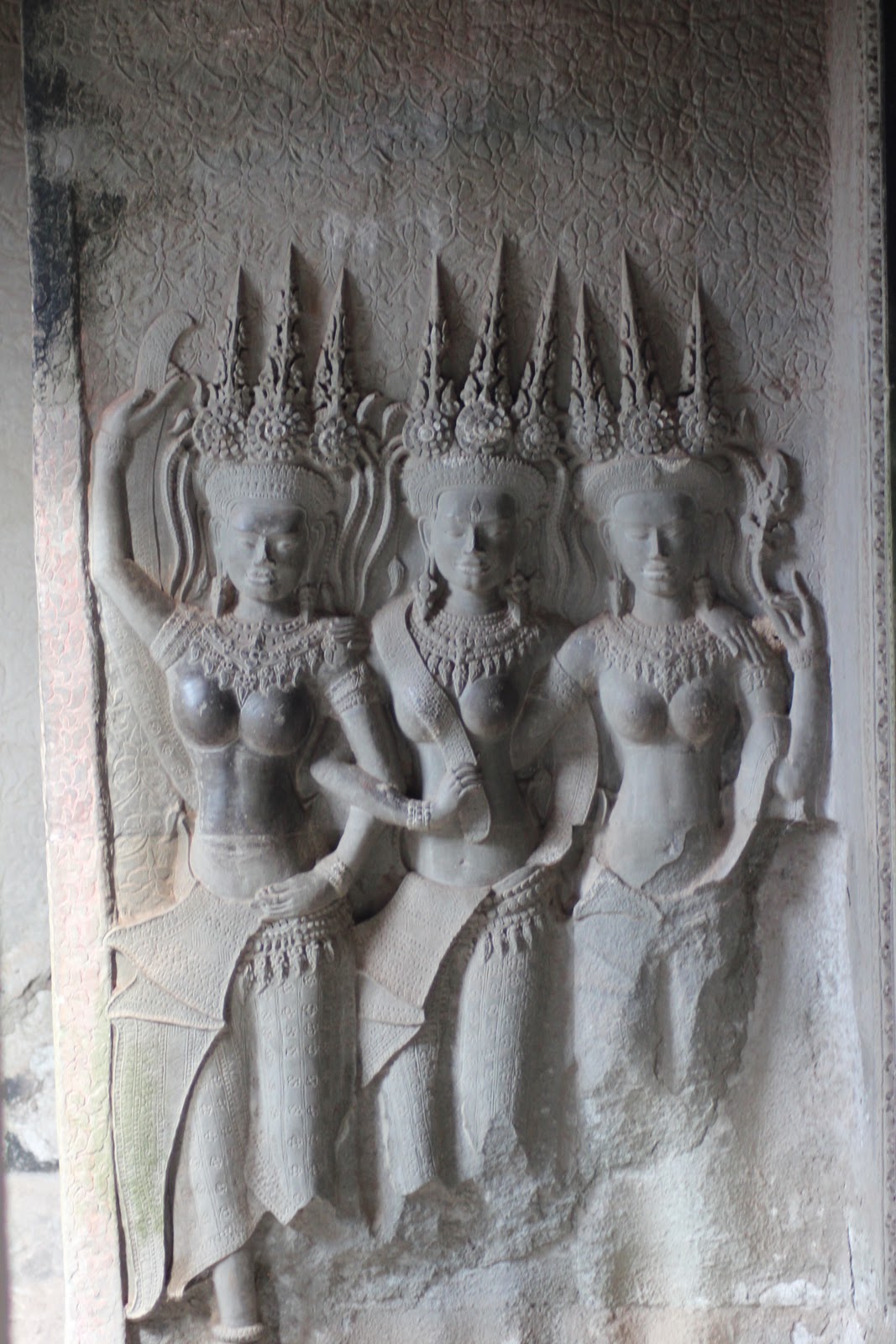
The next morning, most of our group went of at 05.00, in the darkness, to wait for the sunrise over Angkor Wat, the real centre-piece of this vast and hugely impressive temple complex. At Nak's suggestion, we waited outside the walls of this moat-surrounded Wat, and, as our eyes adjusted to the dark and then the dawn, we became aware of hundreds of other coaches turning up with thousands of other tourists all walking along the causeway into the temple complex. Nak's local knowledge was useful here. Not only are the best views of the Wat from outside its walls but, once the sun had risen (sadly, not a particularly spectacular sunrise on this occasion), most of these thousands of tourists trooped back out again, to go back to their hotels for breakfast. And so, with the Wat considerably much less crowded, our group went in for a truly fascinating tour,with Nak able to explain to us the intracies of the stories depicted in the absolutely staggering stone carvings all around this most iconic of temples. Like the other temples in the Angkor complex, Angkor Wat replicates the spatial universe in miniature, the central tower surrounded by smaller peaks, bounded in turn by continents (the lower courtyards) and the oceans (the huge rectangular moat, 4km long and 190m wide). The naga (serpent balustrade) serves as a symbolic 'rainbow bridge', by which Buddhists may reach nirvana.
Just as the tourists started to return in mid-morning, we left Angkor Wat itself, and moved on to Ta Prohm, a strangely ruined temple, locked in the embrace of the powerful, huge, centuries-old trees from the surrounding jungle. The roots of these mighty creatures seem to ooze down over the temple stones and doorways, creating amazingly grotesque, science-fiction like, scenes. This particular temple was apparently the location for a film called Tomb Raider, starring Angelina Jolie, some years ago, a movie which has spawned no end of computer-games of the same name, whose central heroine is called Lara Croft.
After leaving Ta Prohm, we went off with Nak for a boat-trip to Chong Kneas, one of nearly 200 floating villages along the vast lake of Tonle Sap, peopled by as many Vietnamese as Cambodians. Here, thousands of people live, work, trade, play, and educate their children all in floating structures of various kinds, built on huge bamboo rafts. An absolutely fascinating, colourful, seemingly-friendly, world.
After this day of almost sensory-overload (but in a truly positive way), it was back to Siem Reap, a nice meal in a 'Khmer Kitchen' restaurant, and our last night at the comfortable Angkor Way Hotel, to pack for our journey back in the morning to Bangkok - to complete our Intrepid Travel 'Indochina Loop'.




But first we had to take a very comfortable, seven-hour, air-conditioned private bus journey from Phnom Penh to Siem Reap, through absolutely wonderful rural scenery, loads of really interesting small farmsteads, most with houses built on stilts over the lotus-flower strewn ponds which were their 'front gardens', and most with two or three cows or buffalo tethered somewhere near the road. We stopped on the way at a place called Skun village, also known as Tarantula village, because here this arachnoid, fried to a crisp, is a great delicacy (ugh!). In the market here, there were large bowls full of live tarantulas, from which the discerning customer could choose those they'd like to have cooked for them, rather like one might in an up-market fresh fish/lobster restaurant in the West. I have to say that, though some of our group were brave enough to get up close to these eight-legged creatures, I couldn't bring myself to get anywhere near. Andy did, though, and managed to get a photograph of Nak enjoying this particular treat - as you'll see below!
[Incidentally, in response to JJ's comment, no, I didn't actually have to eat the frog in Phnom Penh, but I did, having eaten frogs' legs several times in the past, and to eat the whole body in one seemed a bit of a challenge. It was really quite nice, but tasted mainly of salty cooking oil and garlic! Apart from the crunchy bits, of course. But the spider was different: I've never had spiders' legs before, and the whole spider would have taken several mouthfuls, so my usually healthy appetite took to its two legs and deserted!]
We arrived in Siem Reap, home of our guide Nak, and jumping-off point for the Angor Wat complex, at around 3 pm, and had an orientation walk with him around this mainly tourist-trap town before the sun set. In the evening, we went to a local restaurant in, would you believe it?, Pub Street (!) where, amongst many
fairly Western bars and eateries, there were loads of places offering a seat on the side of large fish-tanks in which you are invited to dangle your feet to allow the fish to eat the dead skin from them. We saw loads of people giggling with delight and slight revulsion, but didn't have time to try them ourselves - perhaps we will at some other point on this trip.
In the evening, we went to a Khmer restaurant in Pub Street, called The Temple, where we watched a beautiful performance by their Apsara dancers. It's difficult to describe this ancient form of dance: it's very balletic, though often with incredibly tiny, immensely graceful, movements of the dancers' feet and hands in particular. The word Apsara is most closely translated as 'nymph', and I was absolutely captivated by the whole show. I have to say, though, that it was clearly a minority interest in our group, and most of them went off elsewhere - mainly to the Halloween celebrations happening in the other very Western bars nearby - leaving Andy and me absolutely riveted to the Aspara dancers' performance. We'll put a photo at the end of the blog, but we do also have some brief video-clips to remind us of this beautiful performance. We also had a really nice traditional Khmer meal beforehand.
The next day, we went off to see two of the temples in the Angkor Wat complex - the Bayon and Banteay Srea. It's worth saying that the temples of Angor are spread out over no less than 40-miles, and it would take several weeks to cover them all. The temples were built between the 8th and the 13th centuries, and range from temples made of bricks to vast stone (sandstone or limestone) temple complexes. They are absolutely mind-blowing, but almost impossible to describe in words. So, we'll stick to some trivialities instead. The whole time we were at these two sites, we were continuously stalked by this woman, whom some of you will have heard of, called Hilary something. Clinton, I think. The problem with being so famous, of course, is that it's difficult for us to shake off these kinds of hangers-on, and so everywhere we went, she and her entourage of security guards turned up just minutes later. We eventually managed to shake her off, and went off with our tour-bus to a local village where we watched people boiling up sugar-cane to make into candy - very sweet indeed. Once again, the village children all came thronging around, and joined in joyfully while we chanted the English words counting from one to ten - rather more delightful than our experience around the temples of Angkor. At the entrances to these places, there are loads of really young children, aged from around 5 to 10 years old, all selling souvenirs in a pretty assertive (though not quite aggressive) way. As soon as a group of tourists turn up, these children swarm all around them, offering just about everything for a dollar or two. Intrepid Travel's policy is that travellers should not buy from these children, as they should really be in school, and it encourages them to be too materialistic and greedy. Nak, however, says that it's not quite that simple. Though primary schooling is supposed to be free, many teachers, whose government salaries are pathetic, demand some kind of payment from their pupils for tuition fees, which means that many families just cannot afford to send their children to school, especially given that large families are still the norm here, with most rural dwellers having 8, 9 or 10 children.
The children themselves, though, seem pretty clued-up in a number of ways. They usually ask "where you flom?", as part of their standard patter and, whenever we said we're from England, most of them could immediately recite something like "Oh, Ingerland - capital London, Plime Mihister David Cameron, use to be Gordoh Blown, but now change". One of our group, a Welshman who was a bit fed up with being harassed by these child-entrepreneurs, said glibly to one of them that he'd buy something if they could name the capital of Wales. Quick as a flash, the child said "Cardiff", and Rod was duty-bound to part with $10 for a load of tatty fridge-magnets, much to the enjoyment of the rest of us. A little later, having myself bought several bangles from one child who wouldn't stop asking me to buy more, I offered to sell him some back for $2 (I'd paid $1); again without hesitation, the 8-year-old said "Okay, I buy for $2, but you buy back for $3". It's a bit humbling being done-over so deftly by these kids!
That evening, Andy and I, together with Michel, a charming young Swiss man in our group, went off to the street market in Siem Reap for some real Khmer food, and found ourselves being served by an equally charming 'lady-boy' - the first we'd seen outside of Thailand
The next morning, most of our group went of at 05.00, in the darkness, to wait for the sunrise over Angkor Wat, the real centre-piece of this vast and hugely impressive temple complex. At Nak's suggestion, we waited outside the walls of this moat-surrounded Wat, and, as our eyes adjusted to the dark and then the dawn, we became aware of hundreds of other coaches turning up with thousands of other tourists all walking along the causeway into the temple complex. Nak's local knowledge was useful here. Not only are the best views of the Wat from outside its walls but, once the sun had risen (sadly, not a particularly spectacular sunrise on this occasion), most of these thousands of tourists trooped back out again, to go back to their hotels for breakfast. And so, with the Wat considerably much less crowded, our group went in for a truly fascinating tour,with Nak able to explain to us the intracies of the stories depicted in the absolutely staggering stone carvings all around this most iconic of temples. Like the other temples in the Angkor complex, Angkor Wat replicates the spatial universe in miniature, the central tower surrounded by smaller peaks, bounded in turn by continents (the lower courtyards) and the oceans (the huge rectangular moat, 4km long and 190m wide). The naga (serpent balustrade) serves as a symbolic 'rainbow bridge', by which Buddhists may reach nirvana.
Just as the tourists started to return in mid-morning, we left Angkor Wat itself, and moved on to Ta Prohm, a strangely ruined temple, locked in the embrace of the powerful, huge, centuries-old trees from the surrounding jungle. The roots of these mighty creatures seem to ooze down over the temple stones and doorways, creating amazingly grotesque, science-fiction like, scenes. This particular temple was apparently the location for a film called Tomb Raider, starring Angelina Jolie, some years ago, a movie which has spawned no end of computer-games of the same name, whose central heroine is called Lara Croft.
After leaving Ta Prohm, we went off with Nak for a boat-trip to Chong Kneas, one of nearly 200 floating villages along the vast lake of Tonle Sap, peopled by as many Vietnamese as Cambodians. Here, thousands of people live, work, trade, play, and educate their children all in floating structures of various kinds, built on huge bamboo rafts. An absolutely fascinating, colourful, seemingly-friendly, world.
After this day of almost sensory-overload (but in a truly positive way), it was back to Siem Reap, a nice meal in a 'Khmer Kitchen' restaurant, and our last night at the comfortable Angkor Way Hotel, to pack for our journey back in the morning to Bangkok - to complete our Intrepid Travel 'Indochina Loop'.
 |
| Should we Load our Kia this Way? |
 |
| Should We Re-Paint Our Summer House? (Floating Village on the Great Lake) |


 |
| More of the Floating Village and the Great Lake. |
 |
| Giant Tree Roots at Ta Prohm. |
 |
| Ta Prohm Again. |
 |
| Wild Monkeys in Grounds of Temple |
 |
| Apsara Dancers |



 |
| Samples of the Thousands of Temple Carvings |

 |
| Angkor Wat at Sunrise |


 |
| Several More Temple Views |

 |
| More Apsara Dancers |
 |
| Nak and the Spider! |
 |
| Local Children Enjoying a Game with Us |
Wednesday, 3 November 2010
Pictures from Phnom Penh.
 |
| River Front |
 |
| Delicacies at Street Stalls (Frogs, Crickets, Beetles, Cockroaches) |
 |
| Andy EATS Whole Crunchy Frog! |
 |
| Ton-Up Monks Order |
 |
| FCC |
 |
| Elephant Walking Main Street |
 |
| River Front from Top of FCC |
 |
| Sunset Over Royal Palace from FCC |
 |
| Outside Our Hotel |
 |
| FIVE People on ONE Moped |
 |
| Central Market |
 |
| Inside Market |
 |
| River Front at Dusk |
 |
| The King's Fireworks |
The Kingdom of Wonder.
This is the term our tour guide, Nak (full name Bunnak Hun) almost always uses to describe his clearly-beloved home country, Cambodia, which he and other Khmers prefer still to call Kampuchea. We arrived in Phnom Penh by public bus, the Mekong Limousine Express - a very comfortable journey indeed, after crossing the border at Poipet, often known as the 'armpit' of Cambodia, well-known for its squalor, sleaze and scams. It was pretty awful! Nak always pronounces Phnom Penh “p’noom pin”, with a very plosive ‘p’ on each word. He explained to us how important it is to pronounce the ‘p’, particularly in the first word. “If you no say the ‘p’, it mean a very bad word: in fact it mean (look away now, mum) ‘fuck’!”.
After a quick orientation walk around the key sites in this compact and laid-back riverside city, we went off to the FCC, the Foreign Correspondents’ Club, for an early evening drink. The FCC is interesting for its fine views over the river, but also for some of the photographs around the place, mainly covering the Pol Pot/Khmer Rouge years – or, at least, the years immediately following the revelations of what the Pol Pot regime had been up to. The Khmer Rouge had closed the borders to all foreigners for some time while it carried out the hideous genocide on its own people – whilst, amazingly, continuing to take its seat in the UN General Assembly. After a good look round the photographs here, we all went off for a meal in the Mith Samlanh restaurant, the original training restaurant set up by Friends International to educate and train street kids, the second of which we’d already visited in Vientiane.
On our first full day here, we’d hoped for a look around the Royal Palace, but it was closed whilst the King took part in a Buddhist ritual to celebrate the 6th anniversary of his accession to the throne. The King, Norodom Sihamoni, is 57 years old but is unmarried and has no children; if this situation does not change soon, apparently the king and the government will have to agree upon a successor from another part of the king’s family. Coincidentally, this is also the year in which his father, former King Norodom Sihanouk, celebrates his 88th birthday, and there were several posters and notices wishing him a happy birthday. Norodom Sihanouk is probably better known in the West. He first acceded to the throne in 1941, while Cambodia was still in French administration. He secured the country’s independence from France in 1953; stepped down from the throne to enter the political arena in 1955 (it was one of his maxims that the king should reign but never govern); became head of state on the death of his father, King Norodom Suramarit, in 1960, was toppled by the Lon Nol government in 1970, spent the Khmer Rouge years under house arrest in the Royal Palace, and finally became the country’s king again when the Pol Pot regime was finally ousted, with help from the Vietnamese army. He abdicated 6 years ago in favour of his son – wonder if Elizabeth and Charles have taken note?
Instead of visiting the Royal Palace, Andy and I took a tuk-tuk tour of the City, visiting, amongst other things, the vast, ochre-yellow coloured, highly domed central market, where I bought a ‘real’ Swatch watch for $3.00.
In the afternoon, the whole group went on a visit to the Killing Fields of Choeung Ek and the genocide museum,formerly the prison where Pol Pot would torture and kill any ‘traitors’ to his version of Maoist communism. First in this category was just about every member of the educated class - indeed wearing glasses was reason enough to be killed - including Nak’s father, who had been a college teacher. Having rid the country of these traitors to the cause, the Khmer Rouge then marched everyone else out of the city - other than their own soldiers - and into the country, to work on the collective farms they’d set up. The regime was incredibly cruel, and most of these 'farmers', though forced into growing rice and crops all year, were starving – thousands to death – and weak most of that time, being allowed only very watery rice porridge once a day. So, for several years, it seems, Phnom Penh was a ghost-city, whilst the rural areas became a slave labour camp. It was another pretty gruelling visit, though less visibly grisly than the exhibits in the War Remnants Museum in HCMC, but a really essential visit for helping to understand what this country has been through.
The Lonely Planet guide has a lovely paragraph which we'd like to quote from: "Despite having Angkor Wat - the eighth wonder of the world - in its backyard, Cambodian's greatest treasure is its people. The Khmers have been to hell and back, but thanks to an unbreakable spirit and infectious optimisim, they have prevailed with their smiles and spirits largely intact".
Back in the city that evening, we were struck by the numbers of VERY large 4-by-4s everywhere – Hummers, Mercedes, BMWs, Lexus - a real contrast to the poverty which surrounds the city. But, as Nak explained, Cambodia is also rife with corruption, and anybody with a government position (which includes many of the former Khmer Rouge (other than the ringleaders, some of whom are about to go on trial in the International Courts, other than Pol pot, who died in the jungle of unknown causes as the Vietnamese liberated the country). The 'foot-soldiers' of this brutal revolution were given an amnesty by the King, soon after the peace accords were drawn up, as a peace and reconciliation attempt to re-build the country.
As we sat for our early evening drink, once again in the FCC, we were thrilled to witness a lovely fireworks display across the river, in honour of the 6th anniversary of the King's coronation. A really good display - but probably no better than Lizzie Harman and her East Hoathly Carnival Society could arrange - perhaps someone should tell her to get up yet another flying charabanc trip, this time to show them over here how it's done!
More soon about out trip tomorrow to Siem Riep and Angkor Wat.
PS: Pictures to follow, in next blog. And by the way, in our previous blog entry, we included a picture incorrectly called ‘Queen in Tuk-Tuk’. This was, of course, ‘Queen in Cyclo’ – that really exciting Cyclo-tour of Saigon that we mentioned in the blog before that. (We do need to be accurate at all times!)
After a quick orientation walk around the key sites in this compact and laid-back riverside city, we went off to the FCC, the Foreign Correspondents’ Club, for an early evening drink. The FCC is interesting for its fine views over the river, but also for some of the photographs around the place, mainly covering the Pol Pot/Khmer Rouge years – or, at least, the years immediately following the revelations of what the Pol Pot regime had been up to. The Khmer Rouge had closed the borders to all foreigners for some time while it carried out the hideous genocide on its own people – whilst, amazingly, continuing to take its seat in the UN General Assembly. After a good look round the photographs here, we all went off for a meal in the Mith Samlanh restaurant, the original training restaurant set up by Friends International to educate and train street kids, the second of which we’d already visited in Vientiane.
On our first full day here, we’d hoped for a look around the Royal Palace, but it was closed whilst the King took part in a Buddhist ritual to celebrate the 6th anniversary of his accession to the throne. The King, Norodom Sihamoni, is 57 years old but is unmarried and has no children; if this situation does not change soon, apparently the king and the government will have to agree upon a successor from another part of the king’s family. Coincidentally, this is also the year in which his father, former King Norodom Sihanouk, celebrates his 88th birthday, and there were several posters and notices wishing him a happy birthday. Norodom Sihanouk is probably better known in the West. He first acceded to the throne in 1941, while Cambodia was still in French administration. He secured the country’s independence from France in 1953; stepped down from the throne to enter the political arena in 1955 (it was one of his maxims that the king should reign but never govern); became head of state on the death of his father, King Norodom Suramarit, in 1960, was toppled by the Lon Nol government in 1970, spent the Khmer Rouge years under house arrest in the Royal Palace, and finally became the country’s king again when the Pol Pot regime was finally ousted, with help from the Vietnamese army. He abdicated 6 years ago in favour of his son – wonder if Elizabeth and Charles have taken note?
Instead of visiting the Royal Palace, Andy and I took a tuk-tuk tour of the City, visiting, amongst other things, the vast, ochre-yellow coloured, highly domed central market, where I bought a ‘real’ Swatch watch for $3.00.
In the afternoon, the whole group went on a visit to the Killing Fields of Choeung Ek and the genocide museum,formerly the prison where Pol Pot would torture and kill any ‘traitors’ to his version of Maoist communism. First in this category was just about every member of the educated class - indeed wearing glasses was reason enough to be killed - including Nak’s father, who had been a college teacher. Having rid the country of these traitors to the cause, the Khmer Rouge then marched everyone else out of the city - other than their own soldiers - and into the country, to work on the collective farms they’d set up. The regime was incredibly cruel, and most of these 'farmers', though forced into growing rice and crops all year, were starving – thousands to death – and weak most of that time, being allowed only very watery rice porridge once a day. So, for several years, it seems, Phnom Penh was a ghost-city, whilst the rural areas became a slave labour camp. It was another pretty gruelling visit, though less visibly grisly than the exhibits in the War Remnants Museum in HCMC, but a really essential visit for helping to understand what this country has been through.
The Lonely Planet guide has a lovely paragraph which we'd like to quote from: "Despite having Angkor Wat - the eighth wonder of the world - in its backyard, Cambodian's greatest treasure is its people. The Khmers have been to hell and back, but thanks to an unbreakable spirit and infectious optimisim, they have prevailed with their smiles and spirits largely intact".
Back in the city that evening, we were struck by the numbers of VERY large 4-by-4s everywhere – Hummers, Mercedes, BMWs, Lexus - a real contrast to the poverty which surrounds the city. But, as Nak explained, Cambodia is also rife with corruption, and anybody with a government position (which includes many of the former Khmer Rouge (other than the ringleaders, some of whom are about to go on trial in the International Courts, other than Pol pot, who died in the jungle of unknown causes as the Vietnamese liberated the country). The 'foot-soldiers' of this brutal revolution were given an amnesty by the King, soon after the peace accords were drawn up, as a peace and reconciliation attempt to re-build the country.
As we sat for our early evening drink, once again in the FCC, we were thrilled to witness a lovely fireworks display across the river, in honour of the 6th anniversary of the King's coronation. A really good display - but probably no better than Lizzie Harman and her East Hoathly Carnival Society could arrange - perhaps someone should tell her to get up yet another flying charabanc trip, this time to show them over here how it's done!
More soon about out trip tomorrow to Siem Riep and Angkor Wat.
PS: Pictures to follow, in next blog. And by the way, in our previous blog entry, we included a picture incorrectly called ‘Queen in Tuk-Tuk’. This was, of course, ‘Queen in Cyclo’ – that really exciting Cyclo-tour of Saigon that we mentioned in the blog before that. (We do need to be accurate at all times!)
Monday, 1 November 2010
Ho Chi Minh City - The Sequel!
 |
| Chinook at War Museum |
 |
| 'PE' in the Park |
 |
| Bee' Cook' on Roo' Ti' |
 |
| Queen on Tuk-Tuk |
Oops, we somehow managed to publish the last blog before we'd finished editing it and adding photos. Just wanted to mention the wonderful sites we saw as we walked through the park which formed the centre reservation of the wide boulevard in which our hotel was located. In the late afternoons, there were several classfuls of students from different secondary schools/colleges, all in different coloured school uniforms, and all doing different forms of synchronised keep-fit, Tai-Chi, or martial arts lessons, each to the tempo set by their teachers' whistles. There were also a couple of band-stands in the park where young people in their twenties and thirties were taking dancing lessons: one concentrating on ballroom dancing, the other on jive. It was interesting to see, in all of these cases, how unself-conscious these young people were at performing in front of one or two curious tourists like us - although most people passed them by without a second glance. Don't think UK teenagers would be so unabashed - it probably wouldn't be thought 'cool' (as in 'cool like a rock star', according to our grandson, Rui). That said, many of the schoolchildren we watched did seem to quite enjoy the attention of our camera every time their teacher was looking the other way, most of them turning to the camera and posing with 'peace' signs whenever they could get away with it. We were also absolutely spell-bound by several games of what we think was called 'hakky-sak'. This was a sort of football-equivalent 'keepy-uppy' game, with usually two people kicking a sort of shuttle-cock to each other over a net. But this particular kicking motion was most unusual: it used the underneath of the foot, rather than the top or toes, and often the players would allow the shuttle-cock to pass over their heads behind their backs, and then flip their leg up behind them - where they could certainly not have been able to see the shuttlecock - to hit the shuttle-cock from behind their backs over the top of their head or shoulders to their opponent. It's really difficult to describe, but incredbly skilful and fast, and made our football keepy-uppy game look pretty easy! We do have a video to show you some time - and will certainly be challenging Cameron, Dylan, Lucca and Rui to have a go, if we can find some shuttlecocks to buy!
Oh, and incidentally, since we didn't caption the photos on the first of these two postings, and for our own record, the photos there were: No. 1 'PE' in the Park; No. 2, Uncle Ho in his city; No. 3, White shark ferry on the Saigon River; No.s. 4 and 5, the Bitexco Financial Tower, complete with helipad; No. 6 Bitexco Tower's next-door neighbours; Nos. 7 and 8, Stall-holder by the Saigon River.
Sunday, 31 October 2010
Ho Ho Ho Chi Minh
Arrived in Ho Chi Minh City (still called Saigon by most people here in the south of Vietnam, apart from government officials) after a short flight from Danang. In the north of Vietnam, it was really tangible how sincere was the reverence and admiration in which Ho Chi Minh was held by the population. Indeed, whilst in Ha Noi we'd visited the 'holiest of holies' when we went to the mausoleum which usually houses his body (against his own wishes - he wanted to be cremated). It's uncannily like Lenin's mausoleum in Moscow. Right now, though, and for two months every year, his body is removed for further embalming injections, mainly in Russia, so we had no opportunity to visit him on this occasion. He's certainly seen in the north, though, as a real hero, on a par with Ghandi or Mandela. Having started the revolutionary movement in 1930 to try to overthrow the French colonial powers (who, I think we've said already, were pretty brutal), he then led his country's opposition to the Japanese invasion during WW2, and then again opposition to the French resumption of power, and then to the American invasion from 1964 to 1973, before finally reunifying the country (north and south Vietnam) in 1975 by sending in tanks to the palace of the American-supported puppet president here in Saigon (one is still there on the front lawn). Not sure quite why, but we haven't encountered the same sense of reverence to Uncle Ho here in the south.
Anyway, after checking into our hotel, we went for lunch at a cafe called Pho 2000. Pho is the Vietnamese word for noodle soup (which is ubiquitous in this City), and the cafe has been called Pho 2000 since the then-outgoing President Bill Clnton, and his daughter Chelsea, dined on that local dish here in November of that year. Not surprisingly, there are several pictures around the walls of this very basic canteen-style cafe. What is surprising, though, in this region of high-tech photographic equipment, is that most of the pictures are pretty faded and lacking in any definition or colour.
After lunch, we walked to the War Remnants Museum, near to the Reunification Palace. I'd defy any westerner to visit this place without coming away sobered, moved to tears, and thoroughly ashamed. The documentary, photographic, and real 'artefactual' evidence of US atrocities on the people of Vietnam is shocking indeed. Hundreds and hundreds of photographs of victims of Agent Orange and other chemical defoliants - children and adults with skin, faces, internal organs, and limbs mutilated by contact with the various acids; the 'tiger cages' - suitcase-sized, barbed wire covered cages in which two or three Vietcong would be held, in foetus position, for days or weeks at a time under the searing heat of the sun, photos of American soldiers disembowelling prisoners, playing football with decapitated heads. and torturing/terrorising women and children in rural villages. And, in the streets today, continuing examples of the genetic effects on those born of parents who were direct victims of chemical warfare, are everywhere. Loads of young people with disabilities of various kinds, but most notably deformed limbs - all of these people, it would seem, determined to overcome their difficulties stoically - we've seen virtually no beggars, except one with a truly horribly burnt-out shell of a face. How the hell the West can believe it holds some kind of moral high ground in world affairs, what with this, Iraq, Guantanamo, Afghanistan, 'extraordinary rendition', we really don't know.
Sorry, rant over now. It was a sobering experience, but we really can't pretend it didn't all happen.
Okay, back to the holiday fun. In the afternoon of our first day, we all went on a 'cyclo-tour' of the City. A cyclo, according to Andy's description, is one half of a bicycle, and one half of a bath-chair, welded together with a steering link in the middle. The interesting thing with these contraptions is that the bath-chair goes out first into the traffic, like a baby in a pushchair - a good cure for constipation! You may remember our description of the traffic in Hanoi (I know Linda does!). Well, it's 10 times as bad (though just slightly more orderly) than that! But it was really good fun, and a great way of seeing a city in a short space of time. The drivers were surprisngly helpful, considering our lack of a common language, in pointing out many interesting sights.
In the evening, we went to have some street-food near to the night-market. On the way, we stopped briefly for a beer in a local bar and, just as were we leaving there, my flip-flop came apart. Within 10 seconds of me noticing this, and deciding that there was nothing else for it but to return to the hotel and change, a young Vietnamese chap came out of nowhere, complete with a shoe-shine/shoe-repair kit, and fixed my flip-flop in 3 minutes flat, for the grand sum of US$1.00 Bloody amazing! I spent several minutes working out whether he'd actually crawled under the table where I'd been sitting, and deliberately sabotaged the flip-flop, but then decided it was about time not to be so cynical!
At the night-market, I had 'beef cooked on roof tile' - which is exactly what it says on the tin. On the table in front of me was placed a thick clay/terracotta plant-pot with a small charcoal fire inside. On top of this was placed a concave, bamboo-shaped roof-tile. I had to dip the uncooked beef and vegetables I was served with into some cooking oil in a small dish, and then cook these ingedients on the roof-tile, which was placed at an angle, so that the excess oil would run off back into the oil dish. Not surprisingly, every so often the oil would trickle into the fire, and flame up wildly, just inches from my face! Just what you need when the weather is already hot and humid! Andy, meanwhile, chose the eel hot-pot; also cooked over a small, table barbecue - and also delicious, apparently!
The second day here, we wandered around the city on foot, just lapping up the local sights. One of the most incongruous sights we came across was a scene which showed both 'yesterday' and 'tomorrow' within a few yards of each other. There's an almost-completed, absolutely huge but stunning building, all glass and steel, being built right on the Saigon River. It's about 60 stories high, with a large heli-pad jutting out in a large semi-circle from about the 40th floor. It's a very graceful, hi-tech, modern building which would not look out of place in Dubai. (And, no, you're wrong- it's not a hostel for the unemployed and disabled, it's actually a financial services office tower, surprise surprise). It's VERY impressive and beautiful - but just turn your eyes 90-degrees, and you'll see absolute squalor, with local people living under a flyover, on make-shift beds, broken down trucks, or hammocks slung between the stanchions - themselves all wrapped around with the most amazingly chaotic and terrifying mass of electricity and telephone wires. Imagine the horror of one member of our group - he's a telecoms engineer from that most orderly of countries, Switzerland, and he spends most of his time open-mouthed and agog at this spaghetti of wiring all over the streets and pavements!
Anyway, after checking into our hotel, we went for lunch at a cafe called Pho 2000. Pho is the Vietnamese word for noodle soup (which is ubiquitous in this City), and the cafe has been called Pho 2000 since the then-outgoing President Bill Clnton, and his daughter Chelsea, dined on that local dish here in November of that year. Not surprisingly, there are several pictures around the walls of this very basic canteen-style cafe. What is surprising, though, in this region of high-tech photographic equipment, is that most of the pictures are pretty faded and lacking in any definition or colour.
After lunch, we walked to the War Remnants Museum, near to the Reunification Palace. I'd defy any westerner to visit this place without coming away sobered, moved to tears, and thoroughly ashamed. The documentary, photographic, and real 'artefactual' evidence of US atrocities on the people of Vietnam is shocking indeed. Hundreds and hundreds of photographs of victims of Agent Orange and other chemical defoliants - children and adults with skin, faces, internal organs, and limbs mutilated by contact with the various acids; the 'tiger cages' - suitcase-sized, barbed wire covered cages in which two or three Vietcong would be held, in foetus position, for days or weeks at a time under the searing heat of the sun, photos of American soldiers disembowelling prisoners, playing football with decapitated heads. and torturing/terrorising women and children in rural villages. And, in the streets today, continuing examples of the genetic effects on those born of parents who were direct victims of chemical warfare, are everywhere. Loads of young people with disabilities of various kinds, but most notably deformed limbs - all of these people, it would seem, determined to overcome their difficulties stoically - we've seen virtually no beggars, except one with a truly horribly burnt-out shell of a face. How the hell the West can believe it holds some kind of moral high ground in world affairs, what with this, Iraq, Guantanamo, Afghanistan, 'extraordinary rendition', we really don't know.
Sorry, rant over now. It was a sobering experience, but we really can't pretend it didn't all happen.
Okay, back to the holiday fun. In the afternoon of our first day, we all went on a 'cyclo-tour' of the City. A cyclo, according to Andy's description, is one half of a bicycle, and one half of a bath-chair, welded together with a steering link in the middle. The interesting thing with these contraptions is that the bath-chair goes out first into the traffic, like a baby in a pushchair - a good cure for constipation! You may remember our description of the traffic in Hanoi (I know Linda does!). Well, it's 10 times as bad (though just slightly more orderly) than that! But it was really good fun, and a great way of seeing a city in a short space of time. The drivers were surprisngly helpful, considering our lack of a common language, in pointing out many interesting sights.
In the evening, we went to have some street-food near to the night-market. On the way, we stopped briefly for a beer in a local bar and, just as were we leaving there, my flip-flop came apart. Within 10 seconds of me noticing this, and deciding that there was nothing else for it but to return to the hotel and change, a young Vietnamese chap came out of nowhere, complete with a shoe-shine/shoe-repair kit, and fixed my flip-flop in 3 minutes flat, for the grand sum of US$1.00 Bloody amazing! I spent several minutes working out whether he'd actually crawled under the table where I'd been sitting, and deliberately sabotaged the flip-flop, but then decided it was about time not to be so cynical!
At the night-market, I had 'beef cooked on roof tile' - which is exactly what it says on the tin. On the table in front of me was placed a thick clay/terracotta plant-pot with a small charcoal fire inside. On top of this was placed a concave, bamboo-shaped roof-tile. I had to dip the uncooked beef and vegetables I was served with into some cooking oil in a small dish, and then cook these ingedients on the roof-tile, which was placed at an angle, so that the excess oil would run off back into the oil dish. Not surprisingly, every so often the oil would trickle into the fire, and flame up wildly, just inches from my face! Just what you need when the weather is already hot and humid! Andy, meanwhile, chose the eel hot-pot; also cooked over a small, table barbecue - and also delicious, apparently!
The second day here, we wandered around the city on foot, just lapping up the local sights. One of the most incongruous sights we came across was a scene which showed both 'yesterday' and 'tomorrow' within a few yards of each other. There's an almost-completed, absolutely huge but stunning building, all glass and steel, being built right on the Saigon River. It's about 60 stories high, with a large heli-pad jutting out in a large semi-circle from about the 40th floor. It's a very graceful, hi-tech, modern building which would not look out of place in Dubai. (And, no, you're wrong- it's not a hostel for the unemployed and disabled, it's actually a financial services office tower, surprise surprise). It's VERY impressive and beautiful - but just turn your eyes 90-degrees, and you'll see absolute squalor, with local people living under a flyover, on make-shift beds, broken down trucks, or hammocks slung between the stanchions - themselves all wrapped around with the most amazingly chaotic and terrifying mass of electricity and telephone wires. Imagine the horror of one member of our group - he's a telecoms engineer from that most orderly of countries, Switzerland, and he spends most of his time open-mouthed and agog at this spaghetti of wiring all over the streets and pavements!
The back-streets of the city were absolutely fascinating. Seems that whole areas specialise in a particular product - a whole street of high-tech hi-fi and telecoms equipment, followed by a whole street full of dried fish shops, then another full of second-hand electrical equipment, and then another row of bathroom fittings and tiles - most of which themselves would not look out of place in the West, were it not for the fact that they'd been left out on the street, covered in dust, for seemingly weeks on end - not the most impressive of sales displays!That evening, we met up with our nephew, Dominic. He's just started working here in HCMC, after spells in Shanghai, Qatar, and Egypt, mainly teaching in English Language Educational Institutions. He's currently an Academic Manager, so does little actual teaching these days. It was great to meet up with him, as we don't seem him too often, albeit that our rendezvous started somewhat chaotically. Andy and I had both booked into a massage parlour in a hotel near to our's for just an hour, which should have left us plenty of time to meet up with Dominic. Somehow, however, it lasted much more than an hour and by the time we were due to meet Dominic, the heavens had opened and, despite having to go only a few yards back to our hotel to find him, I must have looked like a drowned rat when I finally got back to meet him. He and I then decided to dash back to the massage parlour to meet Andy, which meant that, by now, both Dominic and I were absolutely soaked to the skin. Anyway, all's well that ends well, as they say, and Andy and I ended up having a really good 'craic' with Dominic over an admittedly not very inspiring meal (unusual in our experience so far, but we didn't feel much like exploring further for a better restaurant, given that the deluge continued for quite a while).
Then off to bed quite early - next day was an early morning bus journey to the Cambodian border and thence to Pnomh Penh.
 |
| Add caption |


Subscribe to:
Posts (Atom)